I Ching is a divination system based on 64 “typical situations” (the hexagrams), their movements as the situation changes, judgment of “fortune or misfortune”, and advice on the most wise action within the situation.
When casting/consulting the I Ching, the result is 2 Hexagrams – the Primary, and the Hexagram it changes to (“Relating Hexagram”) – for a total possible combinations of 4096 (64×64).
The structure and philosophy of I Ching also forms the foundation for other systems like Feng Shui, and the Five Actions (“elements”).
Kind
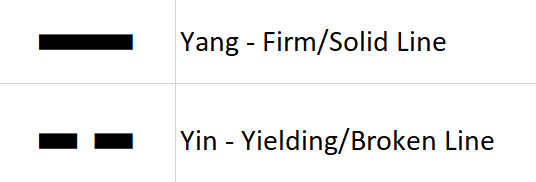
The foundational element in the structure of the hexagrams is the two lines.
- There are two ways of looking at yang/yin – one has more of a fire/water volatile perspective and one has a air/earth more stable perspective
- fire/water – volatile view – active/passive energy
- Yang: Strong – takes action – Light – Resonates/Corresponds to Odd Numbers (elementally fire)
- Yin: Supple – adapts – Dark – Resonates/Corresponds to Even Numbers (elementally water)
- air/earth -stable view – seeing what is or is not
- Yang also can be associated to unity, everything in potential (elementally air) and therefore
- Yin also can be associated to duality (elementary earth), and what has been realized and therefore 1
Di-grams

Balanced is considered more stable, and so the young di-grams are considered stable.
How I picture the movement:
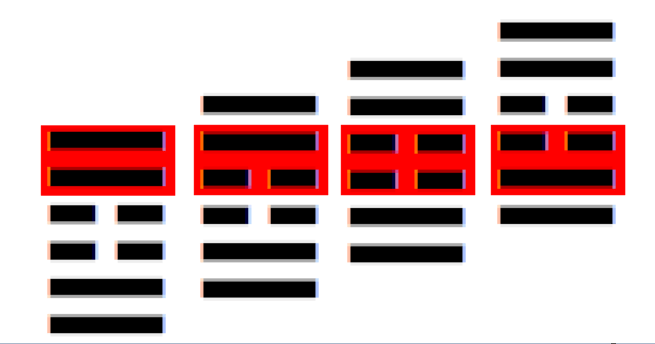
The old is considered at the peak and “transforming”
- Old Yang transforms to Young Yin
- Old Yin transforms to Young Yang
Trigrams
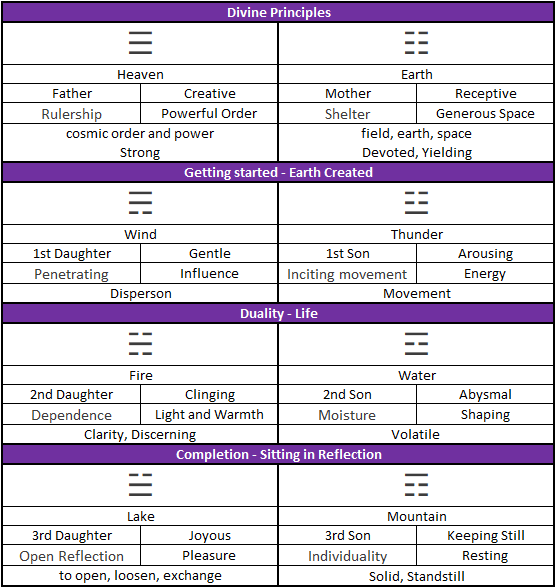
- The trigrams are a combination of 3 lines and make up half of a hexagram.
- They have symbols, common archetypal labels, actions, and family positions
- Within a hexagram (or a “situation”), they representing something “behaving as…[trigram]”
- In the following chart, I have separated them into what I saw as 4 sets of pairs that represent the aspects of change.
- Tip: For family position, it is the one ‘different’ line in the position from the bottom up.
Example: 1st daughter – Yin (female) on the 1st line, and the other 2 lines are Yang

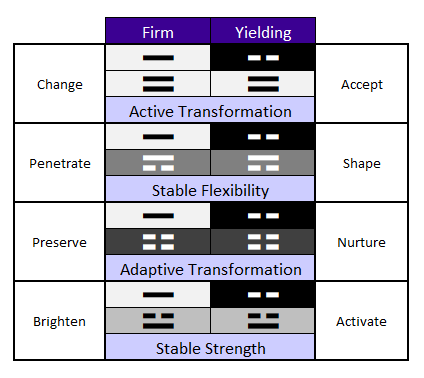
Another way of looking at the trigrams -
Di-grams on the bottom with the third line on top:
i.e. Firm + Active Transformation = Change

 The Scarf Witch
Leave a comment